Tom’s portrait
My PolicemanTom’s portrait is an unfinished drawing project by Patrick Hazlewood, but it also provides the structure for repeated, increasingly intimate meetings with Tom Burgess. The work begins as a carefully staged exercise in looking: uniform, pose, light, and backdrop are arranged so Patrick can draw Tom. Yet the very permission to study him as an artist makes Patrick’s attraction harder to contain. The portrait is at once an artwork in progress and the pretext through which the two men keep returning to one another.
The first sitting and its staging
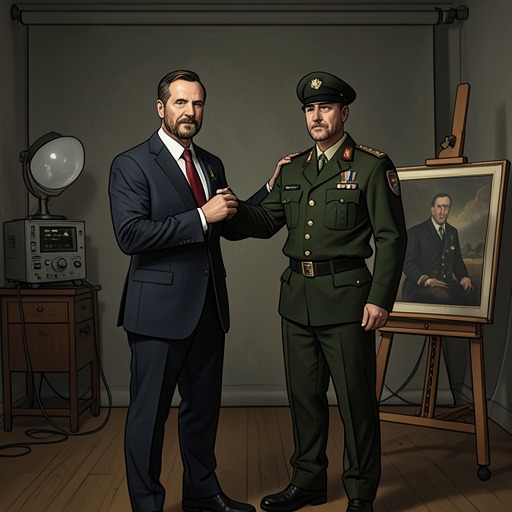
When Tom arrives at Patrick’s flat for a sitting, he is carrying his helmet and wearing his police uniform: a black wool jacket, tightly knotted tie, belt with a silver buckle, whistle chain, polished shoulder number, and shiny boots. Patrick experiences the sight as thrilling and dangerous, but also faintly ridiculous. The uniform makes Tom unmistakably a policeman within the private space of the flat, bringing the authority and public identity of his job into a scene arranged for private observation.
Patrick has prepared the spare room with deliberate care. Tom is to sit on a chair beside the window, with a strong light nearby and an old green tablecloth hung from the curtain rail as a backdrop. Patrick directs him to put his hat on his knees and look into the corner beyond Patrick’s shoulder. The arrangement turns an ordinary room into a makeshift studio, and gives the sitting a disciplined appearance: artist, model, light, pose, and drawing materials each have their place.
The sketchpad, however, has not been used for years. Patrick takes time to find a clean page and select a pencil, practical preparations that also delay the moment when he must look steadily at Tom. Once ready, he realizes he can study him for hours, but freezes at the prospect. The tools intended to make looking routine instead expose how emotionally charged that act has become.
A preliminary sketch and a continuing appointment
The work begins with Patrick managing his gaze in brief peeks. He is afraid he may laugh from joy, laugh at Tom’s youth and brightness, or begin to weep. To continue, he tells himself to take the drawing seriously and tries to see Tom from the inside, recalling an art teacher’s advice about drawing an apple. The artistic task gives Patrick a method for remaining in the room and looking, even as the feelings stirred by Tom make detached observation impossible.
Their eyes meet, and Patrick puts down his pencil, declaring the sitting over for the day. When Tom asks whether the portrait is finished, Patrick explains that it will take several weeks, perhaps longer, and that this is only a preliminary sketch. The unfinished state is not incidental: it establishes a reason for Tom to return. As Tom checks his watch, Patrick suddenly cannot bear to have him leave, but fears that the artful small talk will soon fail and that he will try to touch him, risking rejection. He rushes into arranging another sitting for the same time the following week, unable to meet Tom’s eyes.
The project continues well beyond that first appointment. In November 1957, Patrick records that Tom has agreed to sit and finish the portrait, adding that he will get Tom on paper, whatever it takes. By July, Tom has arranged to spend every Tuesday evening and every other Saturday afternoon with Patrick while the portrait is still being finished. The recurring schedule makes the drawing less a single encounter than an ongoing framework for their time together.
The portrait as a pretext for intimacy
The portrait’s artistic purpose and personal function remain entangled. Patrick uses the language and practices of art to justify sustained attention: he can direct Tom’s pose, observe him closely, and arrange another meeting without having to confess why Tom’s presence matters so much. His determination to get Tom on paper, whatever it takes, gives the project an urgency that exceeds the preliminary sketch described at the first sitting. The image is the stated goal, but the appointments themselves are also what Patrick is trying to preserve.
That double purpose shapes later encounters. Tom and Patrick continue to meet for portrait sittings even as Patrick becomes involved in Tom’s married life. On Thursdays, Patrick sometimes visits Tom and Marion’s home, bringing wine and talking about plays and films. He also proposes art-appreciation afternoons at the museum for Marion’s class; she accepts partly to please Tom and partly because the visit will let her assess Patrick when Tom is absent. The portrait thus connects private sittings to a wider pattern of access and acquaintance, without resolving the tensions among the three people.
As an object, the portrait remains more present as a process than as a described finished image. The evidence emphasizes its preliminary sketch, staged sittings, and continued incompletion, not the appearance of a completed likeness. Its significance lies in this prolonged making: artistic attention gives Patrick a socially intelligible reason to look at Tom, while each promised return deepens the personal stakes of the work. What begins with a strong light, a green cloth, and a policeman posed in a chair becomes a durable arrangement for keeping Tom near.